Thursday, July 28, 2011

mPod: En-Ex


[myPod is a biweekly attempt to edit down my CD collection as I import my music on to my brand new 160 GB iPod. This installment comes a week early, as Picasso Blue is gonna be on vacation for the first half of August.]

Envy

During my senior year of college, I interned with City Paper in Philadelphia for a semester. Most of my writing consisted of brief event summaries, but every so often I got to write something more creatively satisfying. I was also privy to a huge stack of promo CDs that Nate Adams (Science Club/ex-The Percentages) would raid weekly. Most of it was crap, but every so often I’d dig up a treasure like Avail or Envy. At the time, I didn’t quite appreciate Envy’s Abyssal, as I had drifted away from harder music at that point. I started getting into metal after college, though, which led me to the Japanese post-hardcore group’s splits with Thursday and Jesu. Envy bested them both. By 2010’s Recitation, I was hooked on the group’s epic, album-length quiet/loud tension and passion. While I’m unsure about checking out the group’s pre-Abyssal work – they’ve been together almost 20 years – I still love what I’ve heard so far.

Verdict: Keep.

Epoxies


In high school, Epoxies’ retro-leaning punk/new wave revival floored me. Plus, they came recommended by Mitch Clem himself. That said, I just realized I haven’t listened to this band in about five years.

Verdict: Sell.

The Ergs!


One day, The Ergs! will be acknowledged as one of the greatest pop-punk bands of all time, and I’m going to lead the campaign to get them there. While my introduction to the band came via the Ben Kweller and 3 Guys, 12 Eyes EPs, it was Dorkrockcorkrod that solidified my fandom. This band burst with catchy tunes about break-ups and failure. While they only released two proper full-lengths (Dork and Upstairs/Downstairs), their output goes way beyond that, as the rarities collection Hindsigh is 20/20, My Friend attests. And it’s not just me; my fiancée is a fan as well, and she doesn’t even really like pop-punk.

Part of what made The Ergs! great was their musical prowess. The trio obviously had musical interests beyond pop-punk, and their love of jazz and country informed their songwriting. The Ergs! dabbled with different sounds while still maintaining an ooey, gooey pop-punk center. They also played some sweet covers; check out their interpretations of Gin Blossoms’ “Hey Jealousy” and Nirvana’s “Blew” sometime.

I was lucky enough to catch The Ergs! live twice, and both times I raided their merch table for new tunes. Considering their steadily building post-humus discography, I’m still scrambling. Go listen to “Introducing Morrissey” right now.

Verdict: Keep.


Error


While their brief existence only yielded a single EP, Error was something of a super group, featuring Atticus Ross (Nine Inch Nails), Brett Gurewitz (Bad Religion), and Guy Picioto (Dillinger Escape Plan). The result was an industrial band somewhere between NIN and Prodigy. For a while in high school, this was the weirdest album in my collection, but I haven’t put this on in a long, long time.

Verdict: Sell.

Even in Blackouts


I know the last couple bands discussed are getting sold off simply because I don’t listen to them anymore, and while that’s also true for Even in Blackouts, I’ve decided to hold on to Myths & Imaginary Magicians. This project has forced me to rediscover this acoustic pop-punk act featuring Jughead from Screeching Weasel. The record is just super catchy, and they do great covers of SW and Operation Ivy. Also, I just learned they put out a bunch of albums after Myths, so I might check those out.

Verdict: Keep.

The Evens


Ian MacKaye pretty much gets carte blanche with me, but I, like a lot of MacKaye fans, pretended to like The Evens more than I really did back when they were in full force. The acoustic duo of MacKaye and Amy Farina has some neat tunes, but their tunes kind of blur together after a while. RIYL Nick Drake and Ani DiFranco, but bring back Fugazi, please.

Verdict: Sell.


Everclear


For a while, Everclear chronicled the ups and downs of suburban sprawl (decaying neighborhoods, drugs, divorces) in an alt-rock style that bordered on pop-punk. Then they ran out of stuff to say and settled for cloying covers (“Brown Eyed Girl,” “The Boys are Back in Town”) and vacuous “things used to be better” slights (“Volvo Driving Soccer Mom,” “AM Radio”). The band certainly wrote some great tunes, but their song selection is maddeningly uneven to the point that I just don’t know why I own it. There’s some truly great stuff on here (“Strawberry,” “Heroin Girl”) but the majority is overproduced radio rock schlock.

Verdict: Sell.

The Extra Lens/The Extra Glenns


THE MOUNTAIN GOATS ARE AMAZING. GO BUY ALL OF THEIR ALBUMS RIGHT NOW. AFTER THAT GO BUY BOTH ALBUMS FROM THE EXTRA LENS. THEY USED TO BE CALLED THE EXTRA GLENNS BUT NOW THEY’RE NOT.

Martial Arts Weekend and Undercard are both pretty good. Not up to TMG’s level, but you get to hear John Darnielle spin some more tales about failure and sex. Highlight: The jazzy piano tune “Memories” from MAW, which boasts the honest come-on “Will you let me see / Your naked body?” for a chorus. Righteous.

Verdict: Keep.


NEXT TIME: F is for... far out pop tunes, fast punk bands, and fuggin' Fugazi.

Bob Mould - 'See a Little Light: The Trail of Rage and Melody'

Celebrity autobiographies are a tricky thing for the writer and the reader. Celebrities too private to reveal the good stuff – the dirt, the failures, the deepest lows – yield uninteresting books. Sometimes they namedrop too much, producing chapter after chapter of braggadocio. But then, every so often, fans get something really worth reading. Bob Mould’s tell-all, the Michael Azerrad-assisted See a Little Light: The Trail of Rage and Melody, is such a find.

Admittedly, my interest in Mould’s work, at least before picking up this book, was in his seminal ’80s hardcore band Hüsker Dü. I’m a huge fan, and a big part of that comes from Mould’s barking vocals and demonic, otherworldly guitar work. Before My Bloody Valentine and Jawbreaker, there was Hüsker Dü, effortlessly churning out one guitar squall after another. Yet Mould’s years in Hüsker Dü occupy maybe 100 of the book’s 389 pages. But any fan of the band is going to be satisfied with those 100 pages. You get the band’s genesis (Mould met drummer Grant Hart at a record store), the early punk days, the artistic breakthroughs, the major label deals, and the inevitable drug-fueled fallout. All the controversial stuff (Bad Brains’ homophobic attacks, Hart’s drug addition, heck, even the time Joan Rivers accused them of selling out) gets picked through in a matter-of-fact fashion. So do the big creative moments and the glory days.

By his own admission, Mould is an intense, straightforward guy, and his writing reflects that. He tries to get the facts right as best he can, even if it means making himself look like the bad guy on occasion. But I’d be surprised if I found out he held anything back, but everything, from his father’s alcoholism to his own drug battles, comes out. Failed relationships, bad decisions, and songwriting snafus all get discussed. Mould holds very little back.

Which is why it’s such a compelling read, even after Hüsker Dü breaks up. Mould has remained a wealthy artist thanks to smart spending and consistent output, and reading about the ’90s, with the success of Sugar and his solo material, is just as good at the Dü days. The ‘00s deal extensively with Mould’s love life, which is where his openness really pays off. See, Mould spent most of his life covering up his homosexuality, but after getting outed by Spin, he started really dealing with that meant. He immersed himself in gay culture and figured out who he was. As far as I’m concerned, dude’s still pretty punk in his fifties, but the journey he took toward reconciling these different aspects of his personality is inspirational reading for anyone who’s ever felt out of place, regardless of sexual orientation.

This quality plays well with Mould’s conversational approach to writing. He frequently breaks from past tense to give play-by-play notes on some of the weirdest, funniest, and most fucked up moments in his life, putting the reader right in the scene. He also talks about hanging out with legends like Black Flag and Pete Townsend like a music fan. Yeah, some of the chapters bum me out (Mould doesn’t think two highly of my two favorite Hüsker Dü albums, Zen Arcade and Candy Apple Grey), but I also relate to this honesty. As I’ve gotten older, I’ve come to appreciate the later works of artists like Blake Schwarzenbach and Davey von Bohlen of Jawbreaker and The Promise Ring, respectively. Those two artists are judged mostly by the music they created in their early twenties, even though their later material turns out to be just as good as I get older and my tastes evolve. I guess what I’m saying is that even the sections of See a Little Light that let me down are still illuminating.

I’m interested to see what audiences think of the book. As a music fan, I think it’s essential reading, but the book deals with homosexuality just as much as it does with Hüsker Dü. I think the LGBTQ community might get a kick of this book. And if it gets ’em into Hüsker Dü, that’s good too.

Big Business - 'Quadruple Single'

Hot diggity dang, it must be fun being in Big Business. The core duo of bassist/frontman Jared Warren (ex-Tight Bros From Way Back When, which I’m only mentioning because I love the name) and Coady Willis (ex-Murder City Devils) write catchy, sludgy numbers with funny names like “Stareadactyl.” They also joined their favorite band, The Melvins, just because. On top of that, they get to look like a couple of cool guys on stage, with Warren rocking an afro and Willis sporting a Tommy Lee set-up (drumming gloves ‘n’ a headset) behind the kit. Life is good.

And life can be good for you too, if you exchange currency for the band’s new Quadruple Single, a self-released rocker with a penchant for awesomeness. Folks get four tunes on 12-inches of clear orange vinyl (with a digital download, if you roll that way). The packaging is pretty neat too. I mean, the lion on the cover has a sweatband! Hilarious! The labels on the record itself look custom-made with sharpies. I’ve got the band’s name written in black ‘n’ gold on the A side and a puking ghost on the B.

Quadruple Single isn’t just a great visual addition to any home, though. It’s also a sonic journey through the workings of the heart. I think. I don’t know. “Guns” is about how guns are awesome (Sample quote: “Guns! Guns! Guns are better than everything else!”). The lyrics are a little hard to decipher, but I do detect some quality jams occurring. Willis provides supple backbeats, and he really gets to show off on some of the intros. Warren is his typical shouty self, but his low end sure knows how to get down. Guitarist Scott Martin (and, presumably, guitarist Toshi Kasai, who’s sitting out the band’s current tour) brings some nice atmosphere to the arrangement, like on the droning outro to “Ice-Cold War.”

So you see, friends and relatives, Big Business is a must-have for anyone who enjoys fun.

Wednesday, July 27, 2011

Vinyl Vednesday 7/27/2011


[Vinyl Vednesday is a weekly feature about three favorite vinyl finds. It’s not meant to be a dick-measuring contest, but it usually turns out that way. As always, e-mail pelonej1@gmail.com with your own big finds!]

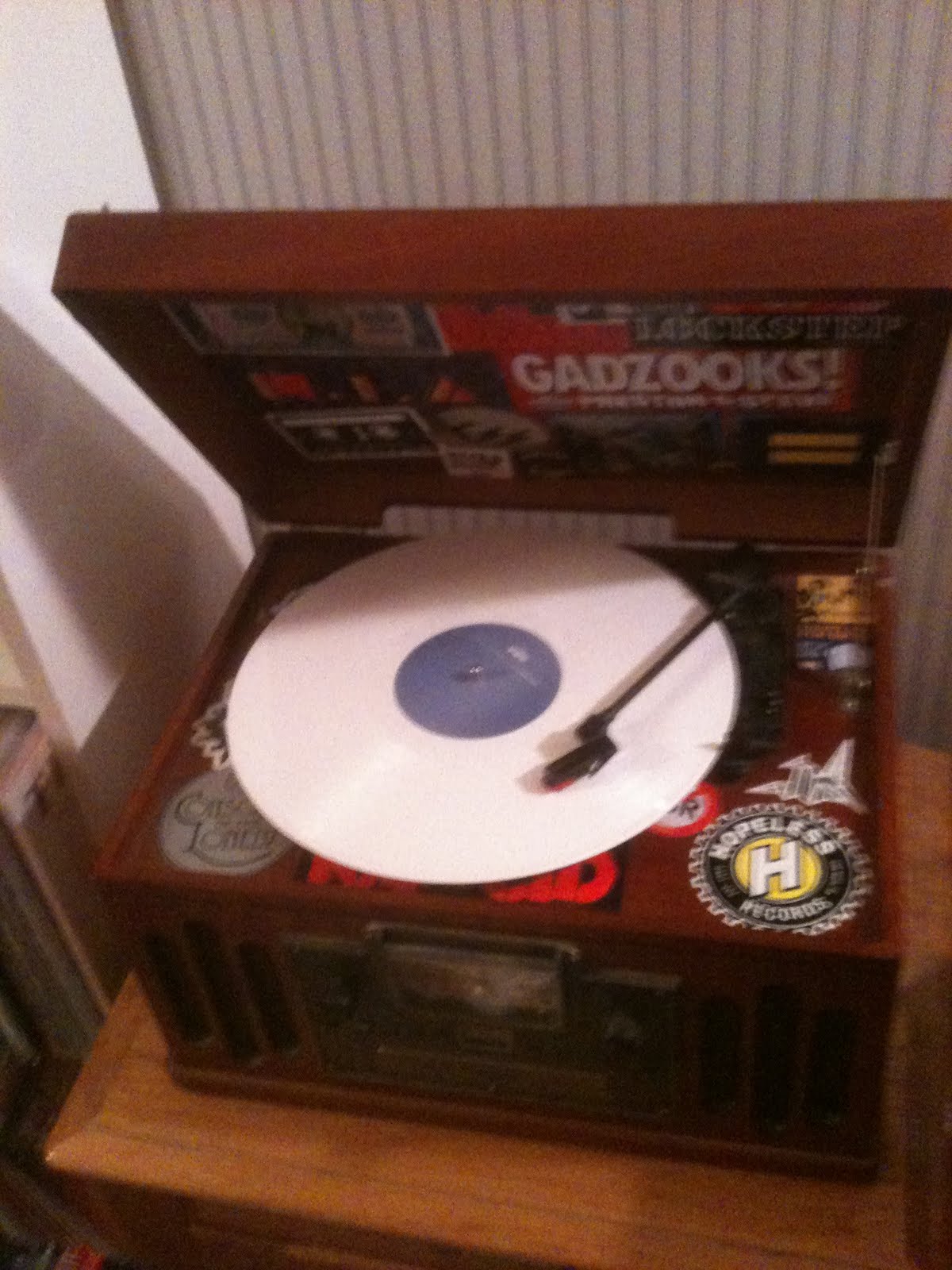
Records: Hans Zimmer’s Dark Knight single (2008) on picture disc, Have Heart’s Songs to Scream at the Sun (2008) on white, and Mott the Hoople’s All the Young Dudes (1972) on black.

Place of Purchase:
Have Heart and Dark Knight were rescued from the bargain bin at Hot Topic. HOOP DREAMZ was part of a triple-vinyl deal on eBay.

Thoughts: I am all about Hans Zimmer, especially when he works with my man Christopher Nolan (Batman Begins, Inception). There’s a featurette on the Dark Knight DVD where you get to watch Zimmer’s process, and the guy is insane. He takes old metal scraps and leather whips and glass and turns it into music. This two-track single doesn’t capture the full majesty of the score, but it looks super cool and delivers the best track of the composition, “Why So Serious?” A sort of theme for the Joker, the song is just all over the place, perfectly capturing the insanity and destruction the Joker causes all over Gotham City. It’s a little on the experimental side, but gloriously so. The other cut, “I am the Batman,” is a whisper of a song. It’s a little disappointing – “Batman” is more of a segue than a proper song on to itself – but “Why So Serious?” still holds up.

Have Heart crossed my path just as they were breaking up, which bums me out. I would have loved to hear this Massachusetts hardcore band rip through “The Same Son” live. What I love about the record is that it balances Paint It Black’s skull-crushing, primal attack with, say, Crime in Stereo’s ethereal post-hardcore flourishes. I’m sure a thousand hXc fanboys just winced at that comparison, but whatever. Point is, go listen to Songs. Shit rips.


I’m a huge David Bowie fan. I even have the Labyrinth soundtrack. Once I more or less completed my Bowie collection (or so I think… I keep picking up the occasional odd ‘n’ end), I dove into his various personal projects from the early ’70s, when he opted to produce all of his favorite artists. While I was already a big Stooges fan by this point, I was still surprised and amazed by Bowie’s work on Iggy Pop’s The Idiot and Lust for Life. Same goes for Lou Reed’s Transformer. But my favorite of the bunch was Mott the Hoople’s All the Young Dudes. While not the best Hoople album (My pick: the uber-pop-leaning The Hoople), Dudes is probably the best gateway record, even though it’s two best tunes weren’t written by the band. Bowie penned “All the Young Dudes,” a love letter to glam rock, specifically because he wanted the Hoople to have a hit. The other knockout is the group’s interpretation of The Velvet Underground’s “Sweet Jane.” I’ll argue it’s the penultimate version with any hipster any day.

Les Demoniaques - 'Teenage Lust'

My first impression of Les Demoniaques’ cover of Jesus & Mary Chains’ “Teenage Lust” was, “Why?” A side project from shoegaze vocalist Tamaryn and Dum Gum Girls leader Dee Dee Penny, the cover is pretty much in line with what the two artists have achieved separately. Further pushing the question is the physical release. Rather than vinyl, the duo went with an etched postcard, a format that’s physical but much more susceptible to wear and tear.

So what I have is a picture of boobs that I paid $5.99 for. Granted, it’s a limited edition printing of boobs with only 1,000 copies in existence, no represses, but it’s still just boobs. Boobs, boobs, boobs.

Boobs.

Yet while I can argue for the inessential nature of this 45, I still have to admit that Les Demoniaques do a great job with “Teenage Lust.” It’s appropriately got that acoustic shoegaze quality folks expect from JAMC, but with cooing female vocals to lend it a whole new kind of haunting grace. The guitars and lyrics glide by, intertwined. It’s appropriately spooky for a quasi-goth band named after a ’70s horror movie. Granted, folks might be better off just finding the digital version, as it’s more environmentally friendly, but the point is that they’re listening. Dum Dum Girls’ next full-length, Only in Dreams, is due in September. While I expect great fuzz-pop things from that group, hopefully Les Demoniaques will evolve into a more substantial act in its own right, something a little more ethereal but just as enchanting.

Monday, July 25, 2011

regarding Amy Winehouse.


Amy Winehouse died over the weekend. The resulting mockery has struck me as weird and insensitive. I'll admit that even I cracked a couple of jokes over it (Junky singer dies a junky death at 27? Who would have thought?), but for a singer with such a slim discography, people sure are determined to rip her to shreds. I blame "Rehab;" if Winehouse hadn't been so frank about her drug use, maybe people wouldn't be so set on mocking her passing.

But then, Winehouse easily spent more time in the limelight as an object of ridicule than adoration. In the four years since her breakthrough sophomore record Back to Black, Winehouse made news as a professional fuck-up, not as a musician. Other artists took her knack for controversy (Lady Gaga) and retro-soul (Duffy) and forged more stable careers. The world moved on, occasionally bringing up the latest Winehouse debacle (bad implants, bad romances, bad habits) for laughs.

Personally, I feel bad for Winehouse and her family. Drug addiction is like a kind of cancer; it goes into remission but it lingers, waiting to come back. I'm not going to pretend I suddenly care about her music - despite my sudden love of '70s soul, I'm still a punk writer - but I certainly still mourn the passing of another human being.

I doubt the last years of her life were good. I hope she's now at peace.

Wednesday, July 20, 2011

Vinyl Vednesday 7/20/2011


[Vinyl Vednesday is a weekly feature about three favorite vinyl finds. It’s not meant to be a dick-measuring contest, but it usually turns out that way. Since I’m currently reading Bob Mould’s autobiography, See a Little Light: The Trail of Rage and Melody, this week’s installment is all about Hüsker Dü. As always, e-mail pelonej1@gmail.com with your own big finds!]

Records:
Hüsker Dü’s Land Speed Record (1982), Metal Circus (1983), and New Day Rising (1985), all on black.

Place of Purchase: Land Speed Record
and New Day Rising both came from Siren Records in Doylestown. Metal Circus was purchased at Repo Records in Philadelphia.

Thoughts: My love of Hüsker Dü took time to build. I picked up Zen Arcade when I was maybe 19 years old, and while I appreciated the dissonance, it wasn’t until a few years later that I really started to fall in love. But once things clicked, I fell hard, and started snapping up Hüsker Dü releases at a rapid clip. Sometimes it paid off, sometimes it didn’t. To be honest, Land Speed Record is one of the less essential Hüsker Dü records. Consisting of two live sets, the fidelity is debatable. Considering it’s an indie live record from the ’80s, it’s just a notch or two above bootleg status. But it captures the band during their most primal punk phase

If you want to know where to start with Hüsker Dü, though, I’d argue for Metal Circus being a good starting point. That’s when the band started evolving beyond simple hardcore speed. While the group hadn’t quite hit the expansive dissonance of Zen Arcade yet, they were nearly there, as tunes like “Diane” and “Real World” attest. Mould already had his signature guitar sound in place – with just a few tweaks, he was able to create this monolithic, otherworldly noise that just devastates me. He gets one of my all-time favorite guitar tones, alongside My Bloody Valentine’s Kevin Shields and Jawbreaker’s Blake Schwarzenbach, and reading his breakdown of how to get there on See a Little Light is amazing. He makes this incredible, unique music seem like the easiest thing to make.

Once you get on board with Metal Circus, you can either dive headfirst into Zen Arcade, or you could take a detour through New Day Rising. Zen Arcade is both Hüsker Dü’s best and most difficult record, and New Day Rising streamlines all the noise into something ever so slightly more mainstream. While it’s not as pop-oriented as Candy Apple Grey, their major label debut, New Day Rising is the record that got the band a record contract with Warner Bros. As a double album, Zen Arcade has a certain amount of sprawl. Granted, New Day Rising is 16 tracks deep, but it still shows a greater emphasis on melody, something the band would develop even further on Flip Your Wig (which Warner Bros. nearly put, but the band opted to give to SST as a farewell present) and Grey. In that sense, it might be the best gateway, as it represents all of the band’s styles at once. It’s a little hardcore in spots, it shows glimmers of what became alternative rock, and it even gets shoegaze-y on occasion.